


Project news
-

© Kiwa Initiative
9 September 2026
Kiwa Initiative IUCN-ORO Team Supports Locally Led Conservation in Papua New Guinea’s Highlands
-

© Kiwa Initiative
23 December 2024
Encouraging results for the KGWan Eco Habitat project!
-

© Etika Qica Kgwan Eco Habitat
26 October 2023
A traditional welcome for Etika Qica in Papua New Guinea
A traditional welcome for Etika Qica in Papua New Guinea
26 October 2023
© Etika Qica Kgwan Eco Habitat
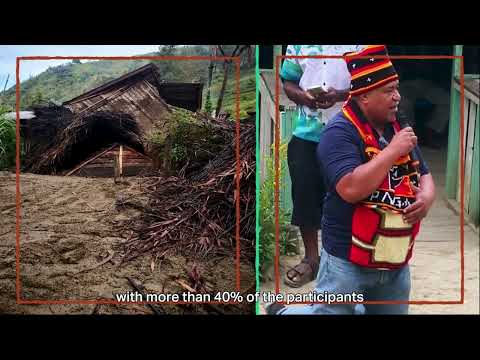
IUCN Kiwa Initaitive Coordinator Etika Qica received a traditional welcome from Inaugl tribe in Papua New Guinea.
Encouraging results for the KGWan Eco Habitat project!
23 December 2024
© Kiwa Initiative
The KGWan Eco Habitat project funded by the Kiwa Initiative, has shared its first results : 800 people have been educated on sustainable management of natural resources within the #Bismarck Forest Corridor, a unique and valuable ecosystem.
Additionally, 42 participants have received training in budget management, a key step in empowering communities and supporting sustainable practices.
See the videoKiwa Initiative IUCN-ORO Team Supports Locally Led Conservation in Papua New Guinea’s Highlands
9 September 2026
© Kiwa Initiative
Simbu Province, Papua New Guinea (24 August- 5 September 2026) — The IUCN Oceania Regional Office (ORO) Kiwa Local Projects team has completed a field mission to the highlands region of Papua New Guinea for on-grantees – KGWan Eco Habitat Inc., Dika Suna Nature Conservation Inc. (DNC), and Kup Reforestation.
The mission marked IUCN-ORO’s first official visit to the Dika Suna Nature Conservation Inc. and Kup Reforestation, and the second to KGWan.
The project team met the project coordinators, visited all three project sites, and saw first-hand progress in locally led conservation and climate resilient work supported by the Kiwa Initiative. The on-grantees then came together for one-on-one technical and financial sessions, strengthening organisational capacity and peer-to-peer learning.
KGWan Eco Habitat Inc.
The project team travelled to the KGWan office located in Danbagl village within the Kundiawa Gembogl district of Simbu Province. In July 2023, KGWan Eco Habitat began adopting and promoting sustainable forest management and climate-smart farming targeting local communities and montane forests within the Inaugl area. The project aimed to improve biodiversity conservation of vulnerable plant species, support climate resilient livelihoods, and drive community awareness and participation. The project was completed in March 2026, having successfully established a Deed of Conservation covering more than 12,000 hectares.
During the visit, the team toured the project’s native plant, coffee and mushroom nurseries, beekeeping facilities and engaged with members of the KGWan staff implementing project activities. Then across two days, the project team facilitated a collaborative session with KGWan to provide targeted support and coaching as the on-grantee completes the grant closure process. Key outcomes include on-grantee submission of key documents, long-term communication strategy and a commitment to deliver on the action plan.
Dika Suna Nature Conservation Inc.
The team followed this with a visit to Dika Suna Nature Conservation Inc (DNC), based also in Simbu Province. Launched in August 2025, this ongoing project works to conserve community forests, restore native plant habitats, and boost climate change awareness and resilience by working together with local village communities. The team visited the Gomani native plants habitat preservation area, a degraded, mountainous area where replanting is taking place. Another degraded site nearby, Kelu’Kelu – a grassland area – is currently being restored with introduced plant species. DNC staff then led a tour around the Drekami community and Dika Suna reforestation areas supporting native planting activities, nursery management, and beekeeping adjacent to the Dika Suna Community Center.
Kup Reforestation
Kup Reforestation is leading forest restoration and conservation efforts in the Kerowagi District of Simbu Province. Since July 2025, Kup Reforestation has raised, distributed and planted tree seedlings within the project site and beyond to restore degraded lands and preserve vulnerable forest ecosystems. The project supports local communities to be active partners in this conservation work, training and upskilling men and women in plant propagation, nursery management, and tree planting.
Kup showed the project team the progress achieved so far, including the central nursery facility critical to reforestation activities along with the Kup project site, tree planting efforts and the stories of landowners implementing reforestation and forest preservation work within and outside the Kup community.
Joint on-grantee sessions
The Kiwa team then held a joint session with Kup Reforestation and Dika Sun Nature Conservation Inc., providing further assistance in finance, grants management, Environmental and Social Management Systems (ESMS), Monitoring, Evaluation, Reporting and Learning (MERL), procurement and communications in line with Kiwa Initiative guidelines.
As beneficiaries of the Kiwa Initiative, the on-grantees welcomed the opportunity to learn from the project team and receive support necessary for project implementation, monitoring and quality assurance.
With this support, KGWan Eco Habitat Inc., Dika Suna Nature Conservation Inc. (DNC), and Kup Reforestation are now equipped to meet pending action plans, deliver targets on time, and maximise funding and project impact.

Theme

co-benefits


-
Project nameImproving Livelihoods through Biodiversity Conservation and Sustainable Climate Systems
-
Project LeadKGWan Eco Habitat
-
Project StartJuly 2023
-
Estimated termMarch 2026
-
Amount of funding€ 55,000, including € 5,000 in counterpart funding from WCS–PNG
Project locations


Simbu Province is a smaller province by land area located in the highlands of Papua New Guinea. The northern most part of the province is renowned for its steep mountainous terrain. This area borders three other provinces : Jiwaka, Madang, and Eastern Highlands Provinces. Montane forests are predominant at this altitude and provide a home to a variety of wildlife like tree kangaroos and birds of paradise that are integral to the biodiversity and cultural identity of Papua New Guinea.
The immediate environmental threats identified in this area are deforestation and land degradation caused by environmental and human activities. Local communities have always depended on forests for food, firewood, medicine, traditional attire, shelter, etc.
The specific goal of the project is to educate, empower and facilitate rural communities of the Inaugl Tribe to participate in natural resource management for livelihood improvement projects that are self-reliance-oriented, technologically appropriate, ecologically sound, and economically viable which address the impacts of climate change.
High average annual rainfall remains somewhat consistent, although patterns and intensity may have changed over time. This combined with steep mountain slopes and reduced forest areas has resulted in landslips, landslides, mudslides, flooding, etc. threatening human lives and infrastructure and causing loss and disturbances to plant & animal ecosystems.
The demand for the Nothofagus tree for community use for its strength and durability has caused the deforestation of the Nothafagus forest of 50 hectares deforested to 20 hectares. It is continuing which needs immediate attention as it is the threatened species identified by IUCN through the red list Nothofagus in 2018.
In April 2020, a major landslide occurred in the neighboring Kegesuglo area causing widespread damage to houses, food gardens, etc., and claimed ten 10 lives after prolonged heavy rains.
Over this time, about 1,000 hectares of forest have been replanted through activities like the reintroduction of native tree species and the introduction of agricultural techniques to maximize crop production on minimal garden plots, however, more work is needed to increase the adaptive capacity of the local communities and their natural environment to build resilience against the negative impact of climate change.
Objectives of the project
The objectives of the project are :
- To ensure sustainable forest management is carried out in 20 000 hectares of montane forest in the Inaugl Tribe as well as reforestation in degradation and deforestation areas to combat the impacts of climate change.
- To ensure more than 1500 community livelihood is improved through producing climate smart food crops to end hunger as well as improving socio-economic and financial resilience.
- To improve biodiversity conservation of the threatened nothofagus species (grandis, fagaraea) in montane forest of the Inaugl Tribe.
Key activities by areas
Climate change adaptation:
- Carry out Community consultation and awareness on sustainable natural resource management
- Distribution of tree seedlings (native & introduced) to communities and schools during world environment day.
- Conduct workshop on disaster risk reduction
Sustainable livelihoods:
- Empower target community with farming materials to do farming with climate smart food crops.
- Encourage target community into farming with appropriate farming tools
- Ensure target farmers gained pre and post-harvest skills and knowledge in farming.
- Encourage target community into farming with appropriate farming tools
- Ensure target farmers gained pre and post-harvest skills and knowledge in farming.
Sustainable resources management:
- Maintenance, upgrade and extension done to the existing nursery yard.
- 10 000 introduced tree seedlings readily available in yard.
- 4000 native tree species readily available in yard.
- 4 hectares of degraded land area being planted with introduced tree species.
- 2 hectares of deforested area being replanted with native tree species.
- Encourage community to build permanent houses using portable ecological sawmill from reforestation and woodlot sites.
Biodiversity:
- Ensure appropriate tools and equipment are available to carry out nursery at the existing yard.
- Ensure nursery is operational throughout the project period.
- Ensure the remaining 20 hectares of nothafagus is buffered and protected.
- Ensure 2 hectares planted with nothafagus species adjoining from the current site.
- Ensure appropriate skills and knowledge imparted to locals as part of capacity building.
- Ensure awareness done throughout the project period as it is the threatened species.
Social inclusion and gender equity
At least 1500 target local communities are educated in awareness of sustainable natural resource management. About 40% will be women. At least 3 primary schools and 7 elementary schools conduct environmental awareness. A proportion of women and men in communities participate and are involved in mainstreaming biodiversity conservation and forest management practices.
We already have a gender program that involves women in various activities that are inclusive. One of the programs that this project will benefit is the savings that women will produce climate-smart food crops to earn income to do their savings. This project will involve more communities participating in and benefiting from it.
Info+
To ensure sustainable natural resource management practices carried out in the Inaugl Tribe of Mitnande LLG. Improved climate change and disaster risk knowledge and awareness of the rural communities.
The organization KGWan Eco Habitat is initiated by the three rival clans in a tribe with a mission statement of “To encourage and promote 20,000 hectares of Inaugls terrestrial biodiversity conservation in Simbu Province, whilst addressing livelihoods and socio-economic needs”. To complement the given statement, the organization has carried out the following programs with some activities to address the needs of communities who benefited from the forest resources for the past 18 years; Natural resource management (sustainable forest management, reforestation, eco-forestry, eco homes).
Livelihood improvement program (vegetable farming, mini livestock, drought-resistant crop multiplication site, marketing accessibility). Gender participation (women's savings, microbank agent in the village, gender inclusive, farming support).


